Word Solitaire Now!
- 4.5
- Rating
- 1.00M
- Installs
- Free
- Price
 Analysis by App-foxy
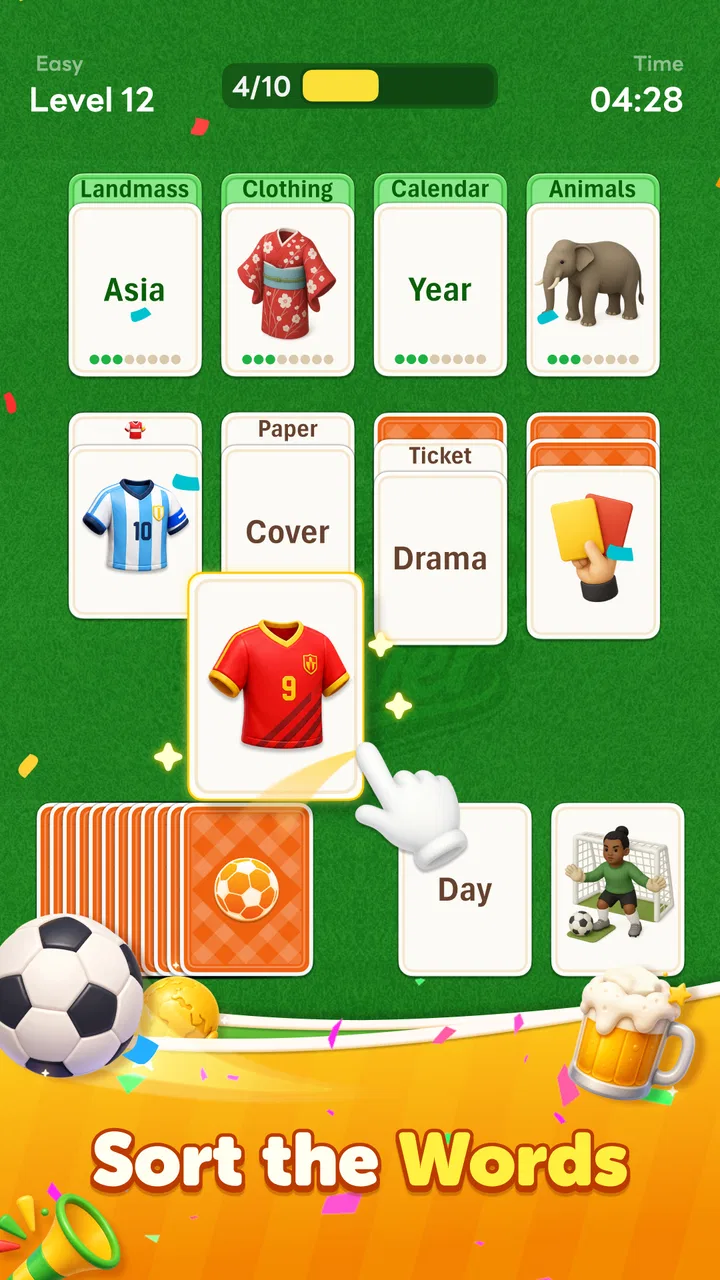
Word Solitaire Now! is the kind of game I open when I want something quiet but still mentally engaging. It takes the familiar patience of solitaire and turns it into a word-sorting challenge, so each move asks me to think about both card-like order and language. The result is calmer than a traditional word scramble, but more active than simply matching letters. I found it especially comfortable for short sessions, although the later decisions can demand much more attention than the relaxed presentation first suggests.
Developed by LOST TEMPLE GAMES, this free word game is aimed at players who enjoy logic puzzles without wanting a loud, hurried experience. It is rated Teen, runs on devices using Android 8.0 or later, and includes optional purchases priced at $9.99 per item. The current version is 1.6.1. Those details matter because this is not just a casual word toy for every age group or every phone; it is a focused puzzle game with a mature content classification and a purchase option that some players will want to keep in mind before handing it to a younger user.
How the basic puzzle loop feels in everyday play
My normal routine with Word Solitaire Now! starts with one quick board rather than a long planned session. I look over the available letters, identify the words that seem most obvious, and then try to avoid spending a useful placement too early. That last part is important. The game rewards patience more than frantic tapping, because a move that looks correct in isolation can make the remaining arrangement harder to read.
You May Also Like

 Blood Strike: 2.5 Anniversary
Blood Strike’s Loadouts Turn Every Drop Into a Tactical Gamble
A close look at Blood Strike’s custom loadouts: how fast access to signature weapons reshapes its battle royale rhythm, rewards preparation, and narrows the gap between fights.

 Pandora - Music & Podcasts
Pandora’s Music Is Easy to Start, but Harder to Recover
Pandora’s strength is its low-effort path from a seed to a station. Its weak spot is how much confidence it asks you to place in connection, setup, and quiet recovery.

 8 Ball Pool
 Is Built on Rivalries, Rematches, and Routine
A close look at the rivalries, rematches, shared routines, and unanswered safety questions that turn a quick pool match into a persistent mobile community.

 Samsung Music
’s Quiet Strength Is Playing What You Already Own
Its reach comes less from spectacle than from dependable access to a personal library. That simplicity is both the app’s strongest retention engine and its ceiling.

 AccuWeather: Weather Radar
AccuWeather Review: A Quick, Clear Forecast for Everyday Decisions
For everyday plans, the best forecast is the one you can understand quickly. AccuWeather makes rain timing, radar, and local conditions easy to act on, with a few trade-offs.

 Hill Climb Racing
Why Hill Climb Racing Still Turns Crashes Into One More Run
A tiny car, a bumpy hill and one more upgrade: Hill Climb Racing keeps resurfacing because its simple chaos makes every near-miss feel personal.
More From Our News Desk



The solitaire influence gives the game a pleasant rhythm. I am not simply hunting for any possible word; I am sorting possibilities and deciding which choice will leave the cleanest path afterward. That makes the experience feel closer to arranging a small logic problem than playing a conventional crossword. It also means that knowing a lot of obscure vocabulary is not always the deciding factor. Careful sequencing can matter just as much as word knowledge.
A realistic use case is a short break between tasks. I can play one round while waiting for an appointment, then stop without feeling that I have abandoned a complicated story or a multiplayer match. The game suits that pause because the central activity is self-contained. On the other hand, I would not choose it when I want instant action or a strong sense of progression through a large fictional world. Its appeal is concentration in a compact format, not spectacle.
The first useful habit is to scan the whole arrangement before committing. I look for short words, repeated letters, and any obvious ending that might restrict the next few placements. I also try to distinguish a move that merely works from a move that keeps several options available. This is a small change in approach, but it reduces the feeling of being trapped by my own earlier decision.
That makes the game approachable without making it mindless. A new player can begin by recognizing simple combinations, while a more experienced player can examine the consequences of each placement. I like that the same board can therefore feel different depending on how carefully I read it. The challenge comes from managing information, not from racing a timer or memorizing a complicated control system.
Why the solitaire format changes word-game habits
Many word games encourage me to produce as many answers as possible. Here, I have to think about order and access. A tempting word may use letters that would be more valuable in another arrangement, while a modest-looking move can open a much better sequence. The strongest approach is usually to preserve flexibility until the board becomes clearer.
I also found it helpful to separate recognition from execution. First I identify several possible words mentally. Then I compare them rather than immediately selecting the first one I notice. This two-step pause is one of the simplest ways to improve consistency, especially on boards where the obvious answer is not necessarily the safest answer.
That workflow makes the game a reasonable fit for players who enjoy anagram puzzles, solitaire, and light deduction at the same time. It is less suitable for someone who dislikes uncertainty or wants every move to have an immediately visible reward. The game asks me to accept that a correct-looking choice can still be strategically poor.
Settings, repeatable habits, and where the challenge shows its limits
I find it useful to treat settings and session habits as part of the puzzle rather than as an afterthought: a comfortable display and a steady pace make it easier to compare letter groups without rushing. A repeatable scan-and-compare routine can make familiar boards feel more manageable, though it cannot remove every awkward choice. That distinction points to the limits of the challenge itself.
What I check before settling into a session
I recommend spending a moment checking the available settings before judging the game. In a puzzle built around reading letters and planning placements, small presentation choices can affect comfort more than players expect. I look for options that make the board easier to follow, reduce distractions, or adjust how the game feels during a quiet session. I would not assume every device presents these choices identically, so I treat the settings screen as part of the initial setup rather than something to ignore.
This is also where I decide how I want to play. If I am tired, I favor a slower, more deliberate routine and avoid turning every board into a personal speed test. If I am using the game as a mental warm-up, I try to make decisions without repeatedly second-guessing them. The same puzzle can serve both purposes, but only if I choose the pace consciously.
One practical tip is to keep the phone in a stable position instead of playing while walking or carrying it. The game depends on visual comparison, and a shifting screen makes it easier to overlook a letter or misread the order. That sounds obvious, but it has a real effect on a puzzle where one missed detail can send the rest of the board in the wrong direction.
I also avoid changing my approach halfway through a board unless I have a clear reason. Constantly switching between searching for short words and planning a complete sequence creates noise. I get better results by using one pass to inspect the board, a second pass to compare candidates, and only then making the move. This repeatable habit is more valuable than trying to play quickly from the start.
Patterns that help experienced players move faster
Speed in this game does not come from tapping faster. It comes from reducing unnecessary thought. I begin by checking for structural clues: letters that can only sensibly belong to a small number of words, endings that suggest a likely completion, and groups that become easier once one obstructing choice is removed. This lets me narrow the board before I start making placements.
Another useful pattern is to protect the letters that connect multiple possibilities. If one letter can help form several likely words, I hesitate before using it in the first available combination. By contrast, a letter with few plausible roles can often be placed earlier without sacrificing much flexibility. This is not a guaranteed rule, but it gives me a practical priority system when several moves appear equally valid.
I also watch for “cleanup” moves. Some choices do not create the most impressive word immediately, but they simplify the remaining board and expose information. I value those moves because they turn a vague puzzle into a smaller one. Players who focus only on the longest or most satisfying word may miss this advantage.
A good everyday workflow is to play the opening conservatively, use the middle of the board to test the strongest pattern, and reserve the final placements for confirmation rather than experimentation. The last stage is where careless assumptions tend to show up. If I have kept enough flexibility, the ending feels like a conclusion. If I have spent every useful option early, it becomes a repair job.
These habits make the game feel deeper than its short description suggests, but they also reveal a trade-off. Players who enjoy discovering their own methods will have plenty to refine. Players who prefer a large collection of explicit mechanics, character upgrades, or changing objectives may find the experience narrow. Its depth comes from decision quality inside the word puzzle, not from a broad system layered around it.
Where the game can frustrate
The relaxed style does not remove frustration. A board can become difficult when several plausible choices compete and the consequences are not immediately obvious. I sometimes know that my current move is legal or sensible but still lack confidence that it is the best route. That uncertainty is part of the challenge, though it may bother anyone looking for a purely soothing game.
The free entry point is welcome, but the optional $9.99-per-item purchases deserve a deliberate look. I would not buy anything automatically. Before spending, I would first decide whether the core loop has earned a regular place in my routine and whether the purchase changes something I genuinely value. For a game designed around simple, repeatable puzzle sessions, impulse spending is easier to regret than it would be in a larger game with many different activities.
The Teen content rating is another reason I would not present it as an unquestioned family game for very young children. The rating does not change how I experience the word puzzles, but parents should still check that the game fits the intended player and review any purchase controls on the device.
Compared with a standard solitaire app, this game gives me more language-based decision-making and less emphasis on suits, ranks, and traditional card layouts. Compared with a crossword, it feels more compact and less dependent on clues or general knowledge. Compared with a rapid anagram game, it is less about producing answers under pressure and more about preserving a workable sequence. Choosing between them depends on the kind of concentration I want: card familiarity, clue solving, or arrangement logic.
Who should play it and who should skip it
I would recommend it to someone who likes word puzzles but wants a calmer pace than a timed challenge. It is also a good match for solitaire players who are ready for a language twist, and for anyone who enjoys improving through repeatable habits rather than unlocking a long list of content. The game works particularly well when I want a small mental reset that still gives me a clear objective.
I would skip it if my priority is competitive play, social interaction, or a highly varied campaign. I would also look elsewhere if I find word puzzles frustrating when the correct path is not obvious. A conventional crossword may be better for players who enjoy clues and themes, while classic solitaire may be preferable for someone who wants familiar card rules without vocabulary decisions.
The audience response suggests that the format has found a substantial following: it holds a 4.5 average from around 26 thousand ratings and has passed 500 thousand installs. I read that as encouraging evidence that the basic loop works for many people, but not as a reason to ignore the personal fit. A popular puzzle can still be the wrong choice if its style of uncertainty does not suit the way you like to play.
My verdict after building a steadier routine
After using the same deliberate process across sessions, I came away with a clear impression: Word Solitaire Now! is strongest when treated as a thoughtful sorting puzzle, not as a disposable word generator. The best results come from scanning before moving, protecting flexible letters, and using cleanup choices to reveal the board. Those techniques make the game more satisfying without requiring invented shortcuts or complicated memorization.
LOST TEMPLE GAMES has kept the central idea focused, and that focus is both the appeal and the limitation. I appreciate being able to start a compact challenge without learning a large ruleset. At the same time, the experience may feel repetitive for players who need constant novelty. The game succeeds because its small decision space has enough room for better and worse habits, not because it offers a huge range of modes.
For me, the final recommendation is positive with sensible boundaries. Try it if you want a free, quiet word game that rewards planning and can fit into an ordinary spare moment. Check the settings early, keep purchases intentional, and do not confuse a fast move with a good move. If you prefer clues, competition, or traditional cards, another puzzle category may serve you better. But when I want a calm board that asks me to think one step ahead, this is an easy game to return to.
FAQs for Word Solitaire Now!
01What is Word Solitaire Now! and how does it work?
Word Solitaire Now! is a unique puzzle game that combines classic solitaire gameplay with word-building challenges. Players are tasked with creating words from a deck of letter cards, strategically placing them in order to clear the board. The game offers various levels of difficulty, making it suitable for both casual players and word enthusiasts.
02Is Word Solitaire Now! free to play?
Yes, Word Solitaire Now! is free to download and play. However, it does offer in-app purchases for additional features, such as hints and extra levels. These purchases are optional, and players can enjoy the core gameplay without spending money. Be sure to check your device's settings to manage in-app purchases.
03Can I play Word Solitaire Now! offline?
Yes, Word Solitaire Now! can be played offline, making it a perfect companion for travels or places with limited internet access. While some features, like leaderboards and daily challenges, require an internet connection, the main gameplay is fully accessible without Wi-Fi or data.
04What devices are compatible with Word Solitaire Now!?
Word Solitaire Now! is available on both Android and iOS platforms. It supports a wide range of devices, but it's always a good idea to check the app's specific requirements in the app store to ensure compatibility with your smartphone or tablet. Regular updates are released to enhance performance and fix any issues.
05How challenging is Word Solitaire Now! for new players?
Word Solitaire Now! offers a variety of difficulty levels to cater to all types of players. Beginners can start with easier levels to get accustomed to the rules, while seasoned players can challenge themselves with more complex puzzles. The game also provides hints and tips to help players progress without frustration.
Pros
- Engaging blend of word puzzles and solitaire.
- Challenging levels with increasing difficulty.
- Visually appealing and intuitive interface.
- Offline play available for on-the-go gaming.
- Regular updates with new puzzles and features.
Cons
- In-app purchases can be expensive.
- Occasional ads may disrupt gameplay.
- Limited hints without purchase.
- Some puzzles can be repetitive.
- Requires internet for leaderboard access.

Word Solitaire Now!
Gallery